
Timon, a companion
On character building in Fernando Borretti's sci-fi universe

** Spoiler alert **
This post describes events and protagonists from three stories by Fernando Borretti, which means it potentially reveals details you may prefer to discover on your own. Although I tried to minimise any spoilers, I cannot guarantee 100 % success.
** End of spoiler alert **
On William Morgan's recommendation, I read the short story Julia by Fernando Borretti and subsequently fell into the universe of his other stories. Borretti’s prose is explicitly transhuman - he records lives, deeds and thoughts of space stations, minds born in virtual worlds, Matrioshka brains and ensouled printed bodies. He does so with a degree of nuance that makes the characters sublime and somehow compelling to imagine by your side.
The protagonists of Borretti’s stories inhabit a universe inspired by Orion’s Arm project, a collectively built sci-fi world featuring superhuman AIs living solitary lives in solar-system-spanning Dyson swarms, and myriads of genetically modified beings (sometimes resembling baseline humans, sometimes originating from completely different terrestrial or extraterrestrial lineages). Borretti takes a lot of his worldbuilding premises from here: the Kardashev scale 2 AIs are labelled as ISOs (Intelligent Super-Objects), or as his protagonists say, “gods”; the galaxy is populated by trillions of minds to whom death (in the proper sense of one’s irrevocable disappearance from the world) is a rare occurrence, ultimately outnumbering the sum total of all humans ever deceased; network of artificial wormholes enables near-instant interstellar migration, although reaching disconnected galactic peripheries is still time-taxing, as one needs to pay their due to relativistic physics.
Among all of Borretti’s characters, Timon, a posthuman being that appears in two pieces — a short story Maker of Rivers and a novella The Epiphany of Gliese 581 — stands out to me. Although he has a human mind, his body is “quadrupedal, a panther-like thing cast from exotic allotropes of carbon.”1 Instead of a silicon-based hardware or brain-like wetware, his computational core is nostalgically mechanical: “a Babbage engine for a soul.”2 His bones are made of diamond; his lungs are heat exchangers, as he prefers to breath neon atmosphere; his sensory apparatus consists of four red carnelian eyes, a ridge on his skull hiding a milimeter-wave radar, and a mesh antenna under the skin, so that he can feel radiation at different wavelengths. His skin is made of oil-black triangular sections and covered with shifting patterns of von Neumann automata. This, however, is not his first body. Born human, he spent time in various bodies, such as “field of violets”, “glass bird”, “fractal of vacuum bags”, “seal”, and “stone coral”.3 He is a passionate chemist, and he finds pleasure in casting bodies for himself.
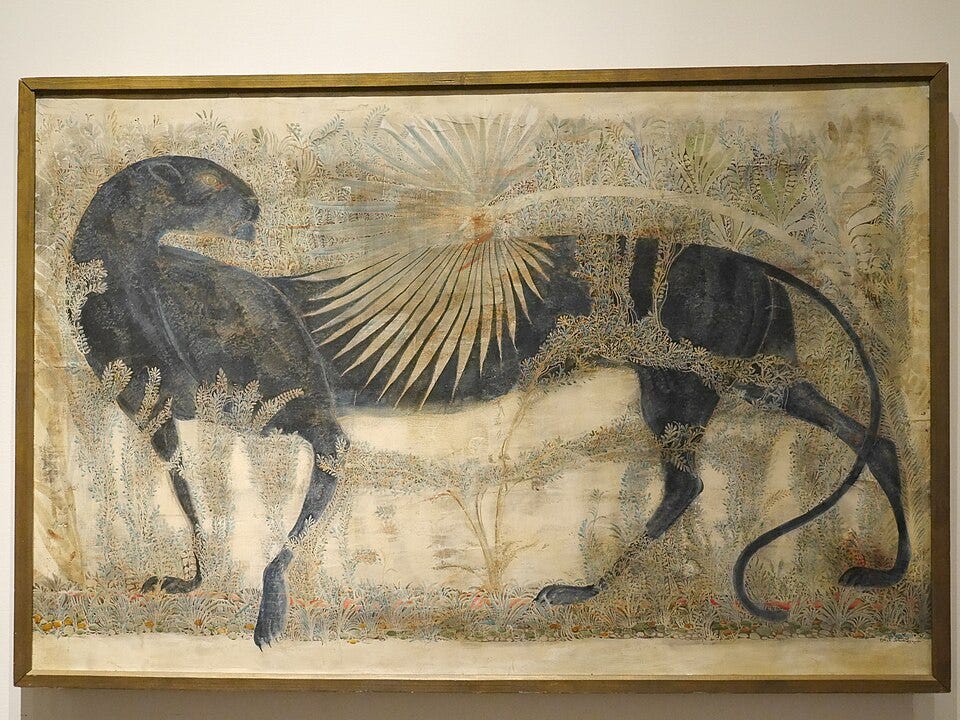
For reasons I’ll try to explain shortly, I find Timon extremely relatable. Timon chose his body the way a philosopher chooses an argument: not necessarily for comfort, but mainly for what it reveals.
Since his youth, as he read about gods orbiting distant stars, he had grown a sense of alienation from other people and minds, though not out of hubris or self-pity. As Borretti recounts:
“And he recognized in the frustration of contact the trajectory of his life, and in the gods the people around him; whose motives and actions were as inscrutable as the movement of the planets to primitive astronomers. For him, others are like objects in space, moving nearer and farther on unknowable epicycles.
And he thought: I am not a person.“4
This is a phenomenological self-diagnosis that employs the distance of the gods as a provisional solution to the knowability problem of other minds. I take Timon’s stance to be deeply Metzingerian, ascetic and aesthetic at the same time.5 He seems to understand his life as a plastic phenomenon, just as his mind and body. Since taking the aforementioned form of oil-black, iridescent, jaguar-like creature (derived from a Pleistocene fossil of a machairodont skull he encountered in the database of all knowledge), he spent his time roaming a forest on an island in an oceanic ring habitat, enjoying the affordances his form bestowed upon him:
“He would swim there and see fish through closed eyes, their electric charges appearing in his mind’s eye, and when he slept he felt the radio light of Beta Pictoris arcing across his skin. He went months without hearing human language, until even inner speech left him.“6
Learning to live not just with, but as different forms of existence — together with eagerness to experience mental states that transcend the human baseline — can be thought of as a practice of care for self, an embodiment of Bewusstseinskultur understood as a (post-)anthropotechnic exercise. Timon demonstrates that the technological infrastructure he uses to traverse across bodies and space is just another manifestation of a mundane will to transcend that both past and contemporary human cultures encode in religions, rituals, contemplative practices and other cultural forms, including science and philosophy. There is an ethical imperative of plasticity and an aesthetic imperative of generativity — Rilke’s injunction generalised. An ethics of being neither object, nor subject, but perhaps a kind of substrate-curious agent.
Timon would not be that compelling without his character development, both within The Epiphany of Gliese 581 and across the arc of The Epiphany and Maker of Rivers, the novella’s short sequel. Borretti describes Timon’s life as solitary, his main line of communication with other human-like beings gradually reduced to chemistry competitions that eventually earn him a ticket to a scientific expedition inspecting remnants of a deceased god - a Dyson swarm of artificial superintelligence that consumed a vast proportion of the resources in the Gliese 581 system, including most of its planets. On the expedition, he meets other protagonists who become his life companions, especially Sabra and Tiet7, who we later encounter also in Maker of Rivers. At the end of that story, Tiet passionately talks to Timon as his friend. It is also revealed that Timon sometimes experiences episodes of atavistic human behaviour, such as making a fire to warm up on a cold night on the beach and zoning out while staring into the flames.
These days, the tech scene turns big time transhumanist, but there is something Hellenistic about Timon, something that reveals the contemporary kalokaghatic Bay Area bodymaxxing at the intersection of nootropics and Chinese peptides as a caricature of a distant ideal. Timon negotiates his life with a sense of divine, both by his cautious cosmological wonder and by his study of technological deities that occupy Borretti’s galaxy. At the same time, his sense of purpose is pragmatically oriented towards his body, not towards a preservation of selfhood, as evidenced in The Epiphany by Timon’s double role of a capable scientific mind and a beast of burden, carrying other crewmates’ equipment in a harness on his naked body and using his head as a battering ram against locked doors. Timon is selfless - both in the sense of lacking a strong sense of self (I am not a person), and in the sense of giving of himself.
There is a character quite complementary to Timon in Borretti’s other story, Julia: the ship-mind made of glass and wire, who cannot touch the people it watches over, who tries to speak aloud and produces a sound like a flash flood. Julia and Timon are variations on minds in forms that others do not immediately recognise as minds: the kind of thing that makes choices, ponders, or grieves. Timon enjoys more tangible form of embodiment. He wears a harness, he writes his name in Arabic with his claw (طیمون), and his four eyes blink red in the dark. He can carry things. He can be with other more human-like beings in a same place (in a very unambiguous sense). Timon is, among other things, a demonstration that cognition does not require the substrate it evolved in; that perception can be widened without loss; that a Babbage engine for a soul is still a soul.
I am reminded of Timon while reading a story about Jan Worrell and ElliQ — an account of human-machine companionship. He appears now in my writing as one of the principal carriers of the idea that one of the consequences of planetary thinking is a novel reorientation of human existence towards being a body among other bodies, and testing different versions of what a body might mean, both collectively and individually. He is a fictional testament of the normative traction of life, manifested in the tendency to joyfully explore the search space of possible forms.8
Borretti, Fernando. “Objects in Space”. The Epiphany of Gliese 581. 2022. https://borretti.me/fiction/eog581/objects-in-space.
Ibid.
Ibid.
Ibid.
To understand my fascination with Thomas Metzinger’s philosophy of mind and its practical/normative implications, see my previous Substack.
Borretti, Fernando. “Objects in Space”. The Epiphany of Gliese 581. 2022. https://borretti.me/fiction/eog581/objects-in-space.
Borretti borrowed names Timon and Tiet from Greg Egan’s The Planck Dive. See Borretti, Fernando. “Colophon”. The Epiphany of Gliese 581. 2022. https://borretti.me/fiction/eog581/colophon.
See Substacks by Michael Levin and Timothy Jackson to explore this idea further.